About The Attuned Shift: Healing from Emotional Abuse in Real Time
Maybe you’re here because you’re questioning everything.
Wondering if you’re too sensitive. If you’re overreacting. If it’s really abuse when they don’t hit you, don’t call you names, don’t leave visible marks.
Maybe you’ve Googled “am I being gaslighted” or “signs of emotional abuse” at 2am. Maybe you’re exhausted from explaining yourself, defending your reality, trying to prove you’re not the problem.
Maybe you keep hoping this time will be different—that if you just love harder, communicate better, try one more time, they’ll finally see you’re worth treating well.
Maybe you stayed because for a moment—or a lot of moments—they made you feel so seen, so chosen, so special. It felt like a full meal because you’d been starving in those areas. Then they turned it on you. Used it against you. Made you question if any of it was ever real.
Maybe you’re stuck in a familiar and vicious cycle—repeat relationship patterns or repeat interactions that leave you feeling confused, constantly disrespected, exhausted, or responsible for your own mistreatment.
I know this place. I lived there for years.
My Journey Through Emotional Abuse and Gaslighting
I’m Simone Adkins—a regular human, licensed therapist, and mother of two adult children.
I’ve come to learn and realize that I’m also a survivor of every form of relationship abuse that started before I could talk.
I can say that I know that now:
The Blueprint That Shaped My Relationships
I grew up learning that love involves harm. That respect is conditional. That if I just became what people needed…
But it wasn’t needed. It was forced, demanded, expected, imposed—even if it wasn’t conscious to the people who hurt me.
I carried that blueprint—AKA attachment style—into every relationship after: my first romantic relationship at 15, friendships, professional settings, my most recent romantic relationship.
I know now that I didn’t choose abusive people because I was broken or had poor judgment. My body was unconsciously trying to heal relationship wounds that were never resolved.
Attachment is survival, which means it’s non-negotiable. When you learn early that love requires self-abandonment, your system signals danger—but attachment can override the gut because we depend on connection to survive.
And over time, many of us never had a chance to learn to trust ourselves, assert our needs, or even feel safe having different preferences from others.
Recognizing the Pattern
The first time I recognized what I was going through, I wasn’t even looking for myself.
I was working toward my therapy license, doing practicum hours, and I picked up a book called The Verbally Abusive Relationship by Patricia Evans for a teenage client.
When I opened it, I saw my own relationship staring back at me. My partner didn’t call me names—but he gaslit the f*ck out of me. Denied things he said. Turned every conflict back on me. Focused on my reaction instead of what caused it.
I’d defend myself, completely confused about why he was suddenly making me out to be someone so different from who he’d always validated and affirmed. He’d see me—really see me—and then take it away.
So back to the book—I put it down immediately. I wasn’t ready.
But I couldn’t unsee it. Eventually, I bought it on my Kindle. I read it. I highlighted it. I started recognizing the pattern wasn’t just my partner—it was my primary caregiver, my first relationship at 15, and repeat relationship patterns throughout my entire relational history.
That recognition didn’t fix anything. It didn’t make me leave. It didn’t even give me clarity right away.
But it started something.
Staying in a Toxic Relationship: Why Leaving Isn’t Simple
Between starting to recognize the abuse and actually leaving, I spent years in the murky middle.
I knew something was wrong, but I kept falling into the same traps and I had a hard time accepting that it was, in fact, abuse.
I’d set boundaries but couldn’t hold them because I’d feel so guilty. I’d call out the disrespect and then wonder if I was being too harsh. I’d feel certain one day and question myself the next.
When You Can’t See the Full Picture
Just because I started to understand the behavior, it didn’t mean I immediately knew how to trust myself or that I immediately lost hope the relationship could work.
I stayed because I wasn’t clear about what I was actually dealing with—that this was a power dynamic. As long as the underlying intent was to get his needs met at my expense, it couldn’t be repaired.
Again, I didn’t know that at the time.
Trauma Bonding: Craving What Hurts You
I stayed because of hope. Because my partner could make me feel so seen, so chosen, so special—needs that went chronically unmet my whole life.
Then he’d turn it on me. Use it against me. Make me feel like I was crazy for wanting what he’d already shown me he could give.
The Practical Realities of Leaving
I stayed because of fear, shame, practical concerns, kids, finances, and the terror of another failed relationship “proving” that it must be me.
Leaving wasn’t a light switch. Clarity didn’t mean I had all the answers—hell, I still don’t.
Healing has involved a sh*t ton of pain, shame, and grief: learning to trust myself, stop judging myself, speak up while feeling overwhelming fear—while supporting others to do the same.
The Moment Things Shifted
Years later, I found out about an emotional affair (maybe more). He denied it, called me insecure, and continued the relationship regardless of how clearly heartbroken I was.
That’s when things shifted for real. I kept landing on articles about emotional abuse and narcissistic traits. I bought another book—So You Married a Narcissist by Freya Strom. Again, I saw myself in that book.
This time I didn’t put sh*t down.
I started writing things down: “How I know [partner] is a liar”—a list that helped me validate what was true in black and white.
And eventually, I got the clarity I’d been praying for. It set everything in motion—the decision to leave several years later, the commitment to heal out loud, and the creation of The Attuned Shift.
Non-Clinical Support for Emotional Abuse and Trauma Recovery
The Attuned Shift is a space I created because not everyone wants or can access therapy, but everyone deserves access to tools that help them shift toward healing and self-acceptance.
This doesn’t replace professional therapy, but it can still be therapeutic. It’s not coaching. It’s not a substitute for clinical support.
It’s education, perspective shifts, and tools grounded in my life experience and professional training—offered to the public outside a therapeutic context.
Who This Is For
It’s for people who:
- Are navigating emotional abuse, gaslighting, covert manipulation, trauma bonding, toxic patterns, confusing dynamics
- Can’t quite name what’s happening but know something’s wrong
- Are still in the situation and not ready (or able) to leave
- Have already left but are still carrying the impact—or are worried about it happening again
- Are tired of self-help that sounds like toxic positivity or blames them for “choosing” abuse
- Want to develop self-trust and interrupt harmful cycles—on their terms, at their pace
The Approach
I heal out loud, in real time, with all my contradictions and mess showing. I don’t position myself as someone who “made it” or “healed.”
I share what I’m learning as I learn it. I combine my personal experiences with my professional knowledge to offer tools, reflections, meditations, eBooks, courses, and daily prompts that create internal shifts—even when external circumstances haven’t changed yet.
What Makes This Different
- No toxic positivity. No “just leave” advice. No expert bullsh*t that ignores reality.
- No permission-giving. I’m not here to tell you what you’re “allowed” to do—you never needed permission.
- No imposed timelines or “shoulds.” Healing isn’t linear. Progress is defined by you.
- Your symptoms, beliefs, and coping aren’t flaws—they’re reasonable responses to unacceptable situations that made sense at the time.
The Philosophy
Early experiences can create a blueprint (attachment style) for relationships, and that blueprint is stored in the body—not logic.
Healing happens in relationships because that’s where harm happens—and the relationship with yourself is the most essential place to rebuild truth, steadiness, and self-trust.
Self-trust is possible even when everything else feels impossible.
What “The Attuned Shift” Means: Building Self-Trust
Attunement is being in tune—with yourself, with what you’re actually experiencing, with what your body is telling you even when your mind is gaslighting you on someone else’s behalf.
The shift is internal. The moment you stop conforming, abandoning, or rejecting yourself and start existing as you actually are.
Shifts don’t have to be big to be profound. Every incremental movement toward trusting yourself matters. Subtle is significant.
This is about interrupting the conditioning and shame that keeps you stuck, small, silent, and disconnected from yourself.
It’s about reconnecting with and reclaiming your relationship with yourself—the first one that got sacrificed because of other relationships that harmed you.
Resources for Recognizing and Healing from Emotional Abuse
Free Tools and Practices
Reflection exercises, meditations, daily Instagram prompts that offer validation and clarity.
Ebooks
Like Walking on Eggshells? —for clarity while you’re still in the confusion. Things you can actually do to prevent yourself from getting sucked into repeat interactions and what you can do once you’re already in them. Real journal entries from my own experience. Resources I actually used. Can be read in a weekend, with brief audio summaries you can listen to anytime.
Courses and Digital Resources
Structured content like journaling practices I’ve used myself to get clear, tell myself the truth, and shift limiting beliefs.
Tools that help you trust yourself, interrupt toxic patterns, recognize signs of emotional abuse and manipulation, and reconnect with your internal authority.
Real Talk
No jargon. No clinical language unless it actually helps. Just human talking to human about what it’s like to navigate this sh*t.
Healing from Trauma: An Ongoing Process, Not a Destination
I don’t treat healing like it’s a destination that only counts if you “arrive.” I believe we heal continuously while learning ways to protect ourselves from repeat harm in relationships.
As long as we live in a world that holds paradox—joy and pain, love and hate, healing and tragedy—we’re all in an ongoing process. That’s not a flaw. That’s not failure. That’s the human condition.
If I’m raw and real and share my experiences without shame—even the shameful ones—people can recognize themselves and heal loudly, in real time, exactly as they are—right alongside me and others working this sh*t out too.
You’re valuable because you exist. Period.
Healing doesn’t require you to be perfect, fixed, or “arrived.” It’s you, showing up for yourself and learning to accept yourself, as you are, over and over again.
My Invitation: Start Your Shift Today
If you’re here—HELL YES—you’re already starting.
You don’t need more proof. You don’t need to be “ready.” You don’t need permission.
Trust that what you’re feeling is real—and that you deserve tools, support, and perspective that meet you where you are without adding pressure to become someone else.
I’m here for you. I want you to get to know me, learn to trust that I care about you, and let me walk with you in this. I want to hear from you about what you need so we can co-create this together.
Let’s shift some sh*t. Together.
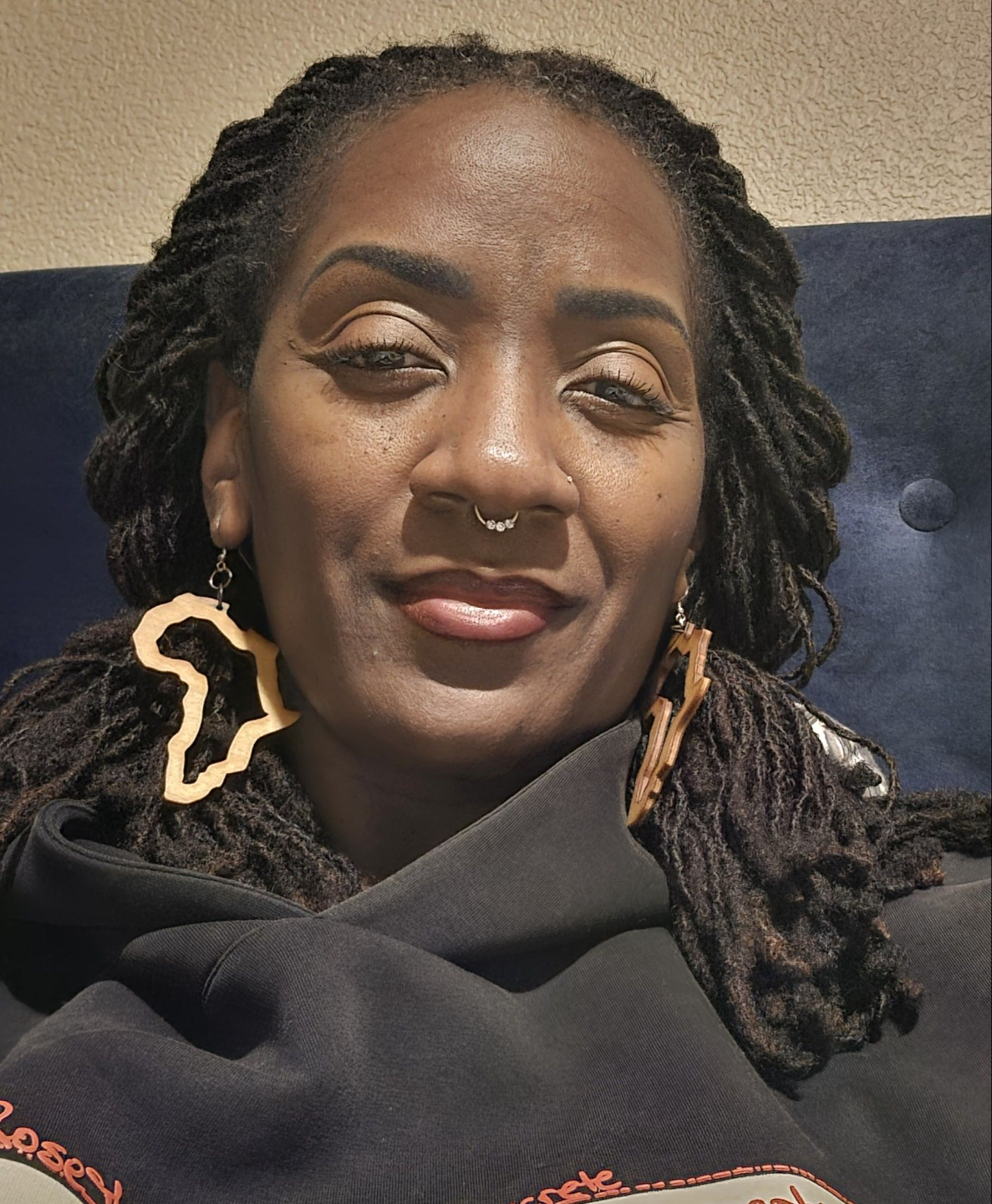
Meet Simone
I know what it’s like to lose connection with yourself — and what it takes to come back home.
I grew up in an environment marked by trauma, abuse, neglect, poverty, and violence. Those early years taught me how to survive, but not how to feel safe, seen, or at home in my own skin.
At 30, I made the decision to return to school while working full-time, pursuing my bachelor’s and master’s degrees in Counseling. It took nine years, countless late nights, and a steady commitment to my own healing to arrive where I am today: a therapist, teacher, and guide devoted to helping others reclaim their sense of self.
Through my work, I support people in cultivating internal freedom — the kind that lets you move through life with more trust, ease, and self-compassion. My approach honors the whole of who you are: body, mind, heart, spirit, and the deeper consciousness that holds it all.
Whether you’re just beginning to turn inward or have been walking this path for years, I’m here to walk alongside you as you discover what it feels like to belong fully to yourself.